Aerodynamics · Automation
Aerodynamic Analysis & Design Targets
Two related efforts: Python/XFOIL screening to choose airfoil candidates, and MATLAB/OptimumLap studies to develop vehicle aerodynamic targets.
Two Related Design Questions
A good starting airfoil and a defensible vehicle target solve different problems. I developed Python/XFOIL automation to screen single-element airfoils by lift and lift-to-drag performance. Separately, I built a MATLAB/OptimumLap workflow to explore vehicle downforce–drag tradeoffs using a preliminary drag polar, alongside Carlos Medina Gutierrez’s feasibility concept. The screening broadened our candidate search; it still needs explicit convergence filtering. Vehicle targets remain provisional until the polar is calibrated and event-weighted scoring is implemented.
Airfoil scale · Python / XFOIL
Which Airfoils Should We Investigate?
Screen many single-element sections to choose candidates for multi-element wing development.
Explore airfoil screening →Vehicle scale · MATLAB / OptimumLap
What Aerodynamic Performance Should We Aim For?
Explore how downforce and drag affect event performance, then work toward feasible vehicle targets.
Explore design targets →Effort 01 · Candidate selection
XFOIL Airfoil Screening
Manually setting up one section at a time limits the search. My goal was to compare a broad set of airfoils and angles of attack quickly enough to guide the choice of a main element.
My Work: Automate the Search
I wrote the Python scripts that run XFOIL cases, collect polar outputs, and compare candidates by lift coefficient and lift-to-drag ratio. The NACA four-digit generator defines 720 candidate sections and uses 12 worker threads. A separate DAT-file workflow produced 4,032 polar files in the supplied records. These counts describe candidates and output files; they do not establish that every case converged.
Screen, Compare, Then Refine
- Run a broad candidate set across angles of attack.
- Compare lift and lift-to-drag performance to shortlist promising sections.
- Study nearby geometries and refine the shortlist before developing a multi-element arrangement.
Parallel execution made the broader search practical. In my setup, XFOIL windows occupied the screen during execution, so this was not a fully unattended background workflow.
Result & Limitations
The working automation expanded the range of airfoils we could consider. My experience-based estimate is roughly 1,000 airfoils in 10 minutes, compared with about five minutes to set up each case manually. That suggests over 80 hours of repetitive setup avoided for that example; it is not a measured labor-saving or runtime study.
This is single-element screening. A strong XFOIL result does not establish the downforce or drag of an interacting wing or the complete car. Candidate comparisons still need explicit convergence and failure filtering.
Next for This Effort
Document the screening and rejection criteria, record repeatable timing, and use the shortlisted sections in multi-element analysis.
Effort 02 · Vehicle performance
Vehicle Aerodynamic Targets
The team needs a reason to pursue a particular combination of downforce and drag. This effort asks how different CL–CD pairs affect event times and how achievable those pairs are.
My Work: Build a Preliminary Trade Study
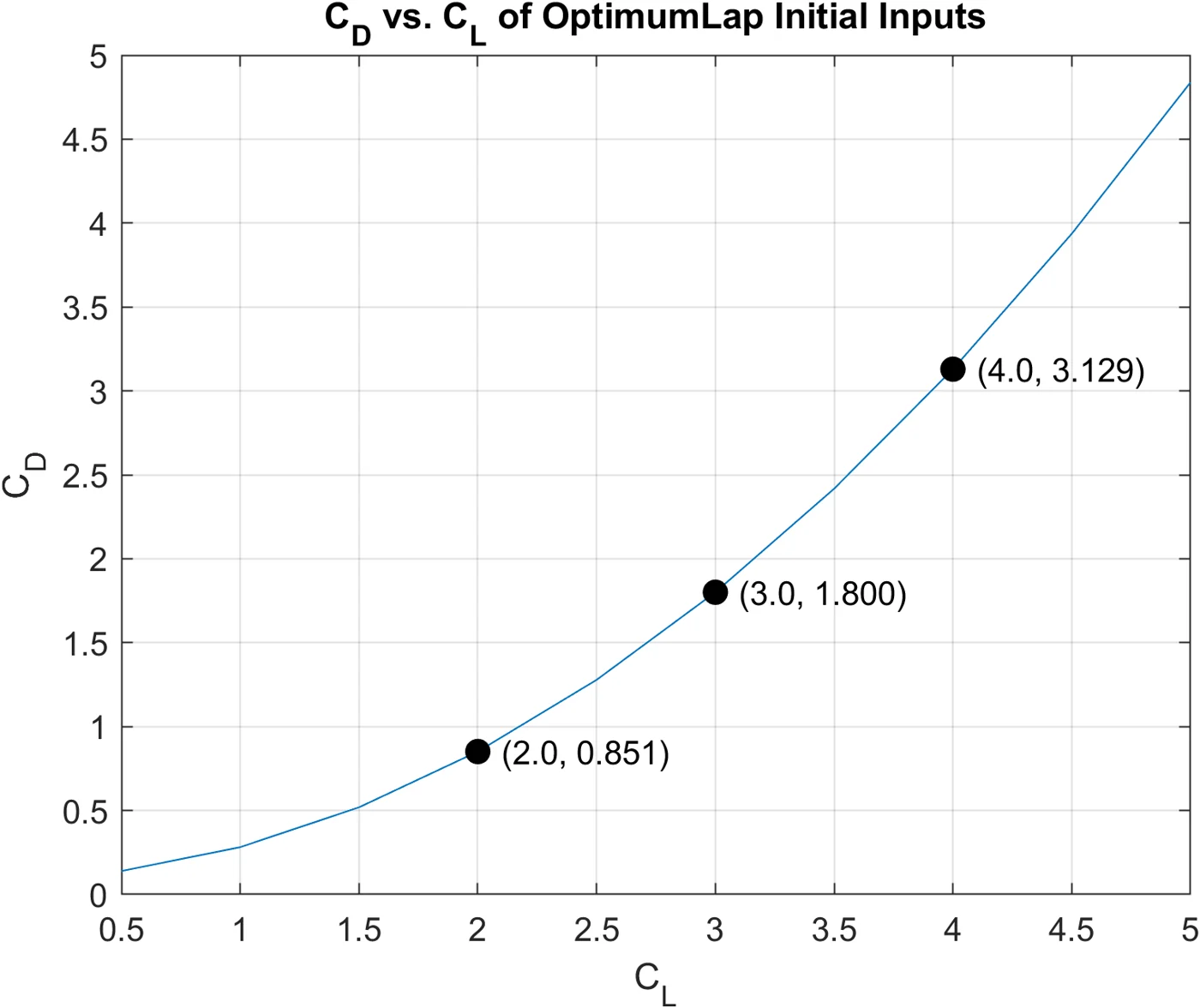
I created the MATLAB workflow to fit a drag polar of the form CD = CD0 + kCL² and generate paired inputs for OptimumLap. Initial data came from the available isolated-wing predictions. In constructing the initial polar, the script reduced predicted lift by 33% and increased predicted drag by 33%. These corrections are provisional assumptions requiring calibration.
OptimumLap models the car as a point mass. The supplied engine, weight, and traction inputs came from the car used at the 2026 competition. These assumptions allow an initial comparison of downforce benefits and drag penalties, but they do not yet provide a calibrated full-vehicle prediction.
Separate Performance Benefit from Feasibility
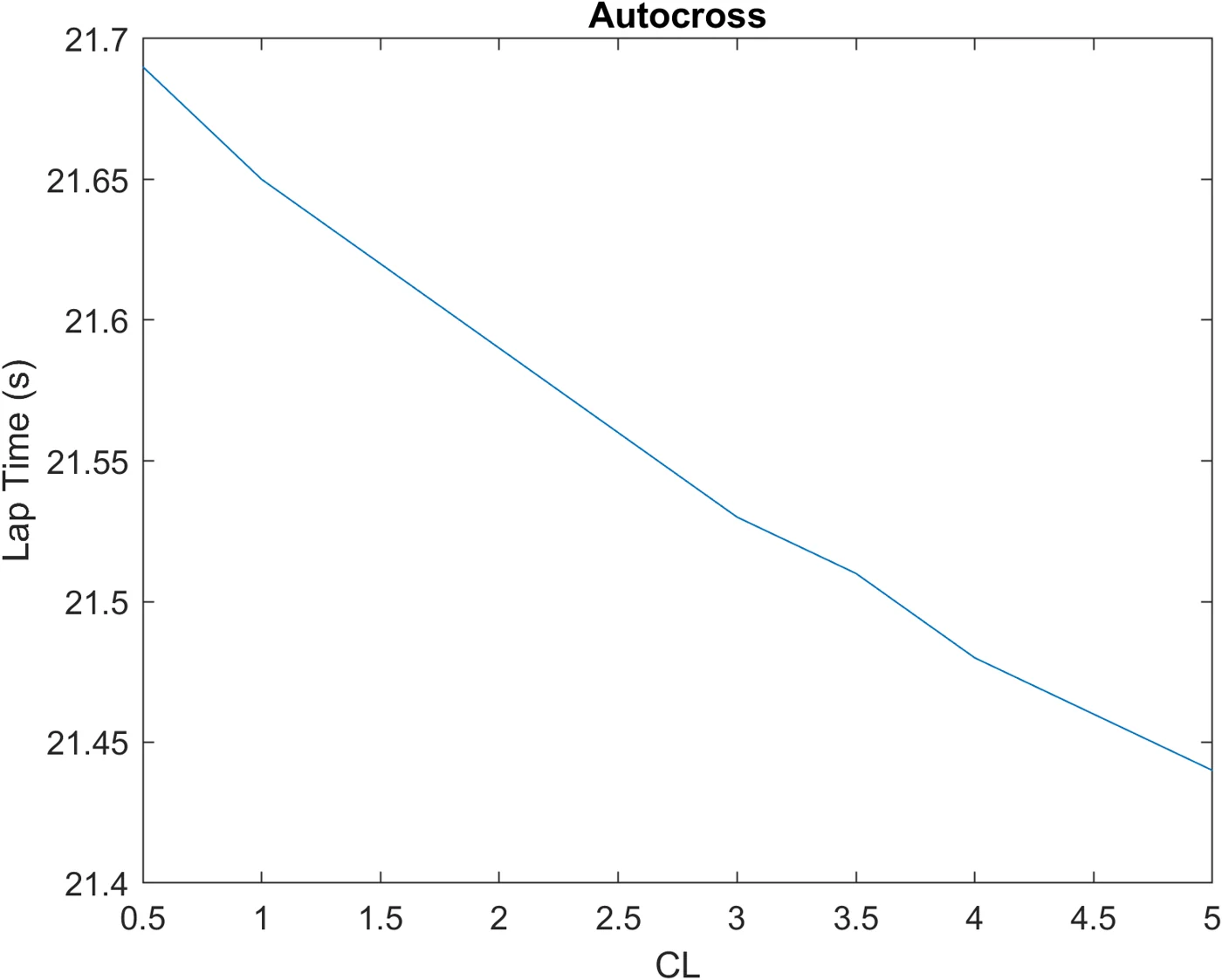
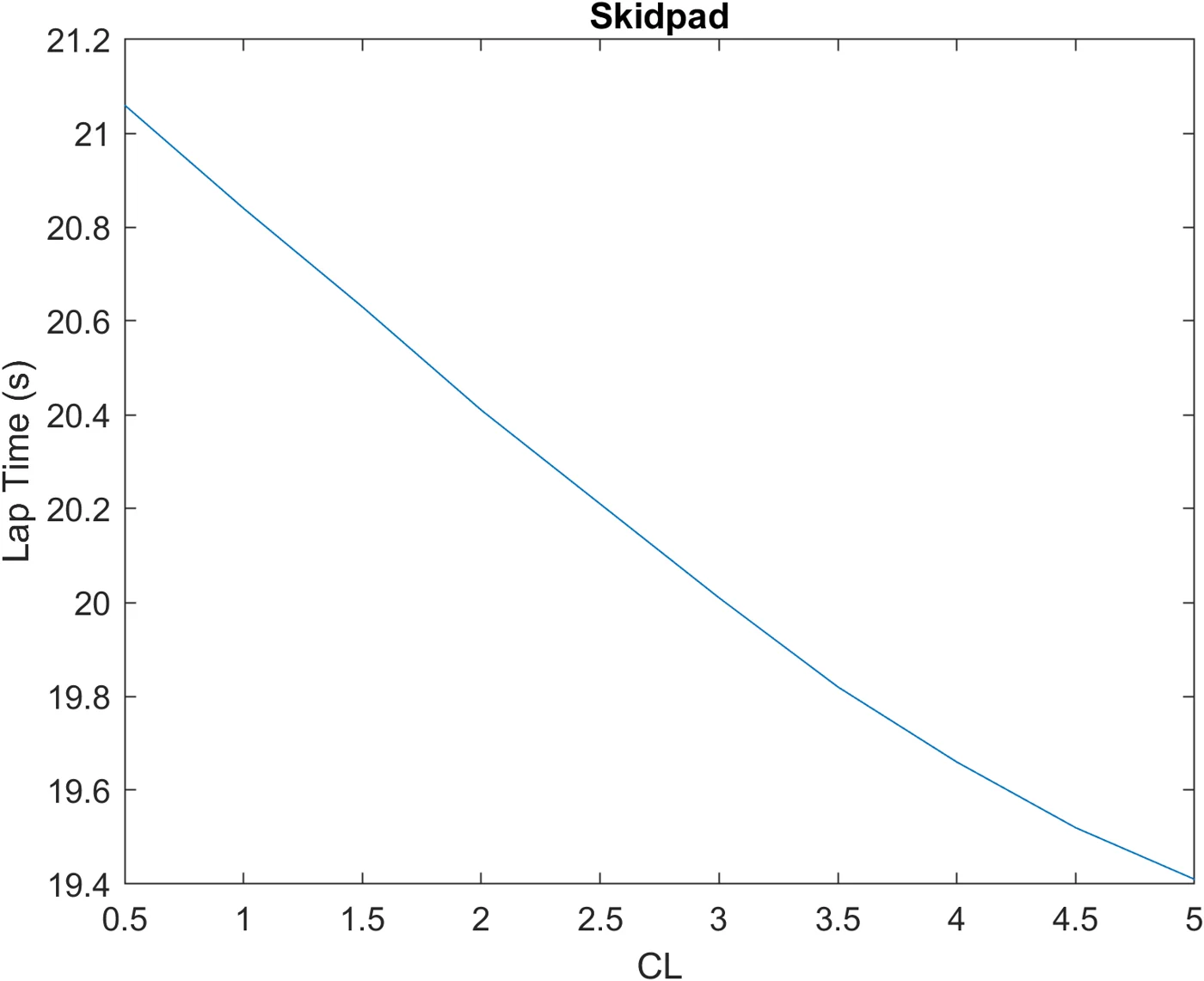
The preliminary studies continued to favor added downforce even at very high lift coefficients. That is a prompt to constrain the search, rather than an instruction to build an unattainable wing. Carlos Medina Gutierrez developed the target-versus-iteration feasibility concept: the achievable target should reflect how much design iteration the team can complete.
The intended selection method will combine performance, feasibility, event points, and the car’s expected competitiveness. That event-weighted scoring method is still under development.
Preliminary Results
The plots below demonstrate the vehicle-target process under the supplied assumptions. They are not XFOIL screening results, measured vehicle performance, or final design targets.
Next for This Effort
Calibrate the polar with measured vehicle loads, revisit the isolated-wing corrections, add competition tracks, and implement the event-weighted CL–CD selection. The load-measurement capstone is intended to support that calibration once testing is complete.
How the Efforts Connect
XFOIL screening helps select the airfoil geometry to investigate. Multi-element and 3D analysis then help assess the wing configuration. The vehicle-target study helps judge what combination of downforce and drag is worth pursuing within the team’s practical limits.
The tools inform the same design decisions at different scales. Single-airfoil polars are not a direct substitute for the full-vehicle drag polar used in the target study.
Team Credits
Python and MATLAB workflow: David Stout. Target-versus-iteration feasibility concept: Carlos Medina Gutierrez. Supplied rear-wing iteration data: Carlos Medina Gutierrez.
Supporting Files
XFOIL airfoil screening
Python scripts & selected XFOIL outputs (download ZIP)Vehicle aerodynamic targets
MATLAB & OptimumLap records (download ZIP)
Downloads are public copies with identifying file metadata removed. Project status and team credits above describe their scope; source packages include notes on their use.